
Dr. Yang Li | 李阳

Aging is characterized by a progressive decline in cellular homeostasis, leading to the accumulation of damaged macromolecules, protein aggregation, and increased susceptibility to age-related diseases such as Alzheimer’s, Parkinson’s, and Huntington’s disease. A key hallmark of aging is the loss of proteostasis – the ability to maintain a properly folded and functional proteome. Among the cellular systems that guard against proteotoxicity, lysosomes play a central role. Lysosomes are the major degradation hubs of the cell, responsible for breaking down misfolded proteins, damaged organelles, and other cellular waste through acidic hydrolases. With age, lysosomal function declines, contributing directly to the pathology of multiple neurodegenerative disorders. Understanding how to boost lysosomal activity to counter aging and protect against disease is therefore a major goal in aging research.
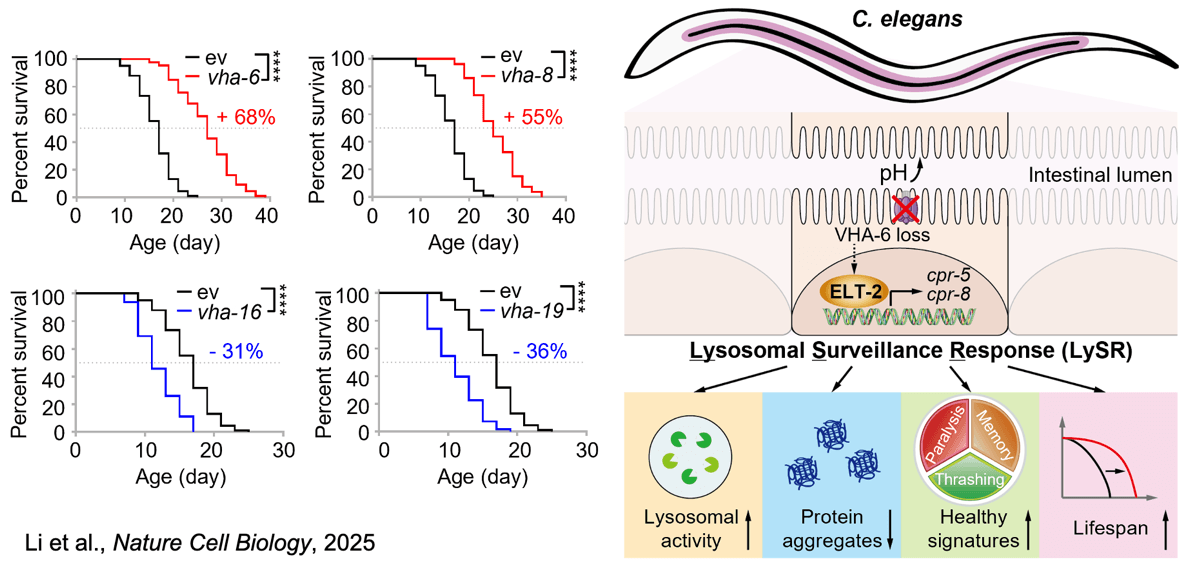
In our recent research, we have uncovered a novel adaptive transcriptional response, termed the lysosomal surveillance response (LysR), which is activated by knocking down specific v-ATPase subunits (e.g., vha-6) in C. elegans. This response is characterized by the strong induction of lysosomal and proteolysis-related genes, leading to increased lysosomal activity, enhanced clearance of protein aggregates in worm models of several neurodegenerative diseases, and a remarkable ~60% lifespan extension.
Figure legend: In C. elegans, RNAi of specific intestinal apical membrane-localized v-ATPase subunits (e.g., vha-6 RNAi) leads to intestinal lumen pH increase and activates an adaptive lysosomal surveillance response (LySR) that is controlled by the GATA transcription factor ELT-2. Activation of LySR is typified by the up-regulation of a large panel of lysosome/proteolysis-related genes (e.g., cpr-5 and cpr-8) and thereby boosts lysosomal activity, reduces protein aggregates, improves healthy signatures, and extends lifespan in several models of neurodegenerative diseases and of normal aging.
By employing state-of-the-art genetic, molecular biology, pharmacological and bioinformatic approaches applied in C. elegans, mice and mammalian cells, our laboratory aims to reveal the systematic and molecular mechanisms of metabolic adaptations in response to stresses and aging, and seek ways to promote organismal health and longevity. Our research focuses on:
- The cellular and metabolic basis of aging and aging-related diseases
- The metabolic adaptations/stress responses in organismal health and longevity
- Explore and develop interventions to promote organismal healthspan extension